In the harsh environment of Australian open-cut mining, reliability is everything. Every minute of production counts, and every breakdown has a price tag.
For operators of heavy mining equipment, that price can easily run into tens of thousands of dollars per incident — not just in repairs, but in lost production, idle crews, and recovery coordination.
Early Hot Spot Detection
To combat this, an increasing number of mines and civil construction companies across the country are adopting thermal imaging inspections as part of their predictive maintenance programs.
By using handheld infrared cameras, maintenance teams are now able to “see the heat” — identifying hot spots and anomalies in machinery long before they become failures.
Keeping Dozers Moving
Few machines work harder in an open-cut mine than a Caterpillar dozer. Weighing over 100 tonnes and delivering up to 850 horsepower, it’s a frontline machine that moves massive volumes of overburden, clears work areas for other mobile plant.
But that same level of heavy use creates significant mechanical stress, especially in tracks, drive, and drive train assemblies.
When a dozer goes down unexpectedly, production can grind to a halt. Replacing an undercarriage or track group can take multiple shifts to complete. It often requires specialised lifting equipment and replacement parts that might not be immediately available on-site.
Hot Joint on Dozer Track
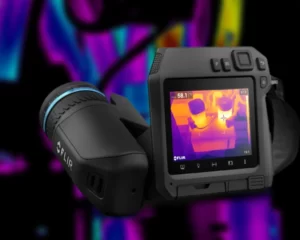
This is exactly the scenario that Grant from GTEK Infrared found when demonstrating a FLIR T865 thermal camera on a regional mining site.
Using a telephoto lens, this infrared video was captured around 80 meters from the dozer. The video shows 3 pins on the right hand track with elevated temperatures. Nearby mine personal were advised of the heat spike, but the dozer could not be stopped for preventative maintenance.
Later that evening the right-hand track broke, stranding the dozer atop of the steep stockpile. Large cranes had to be bought in to stabilise the machine and replace the track. As with all unscheduled breakdowns this causes potential production delays and added costs to maintain the equipment.

From Reactive to Predictive Maintenance
Traditional maintenance programs are time-based, with inspections and servicing carried out at fixed intervals. While this approach ensures regular checks, it often fails to account for real-world wear patterns — particularly in high-stress mining conditions where components can degrade faster than expected.
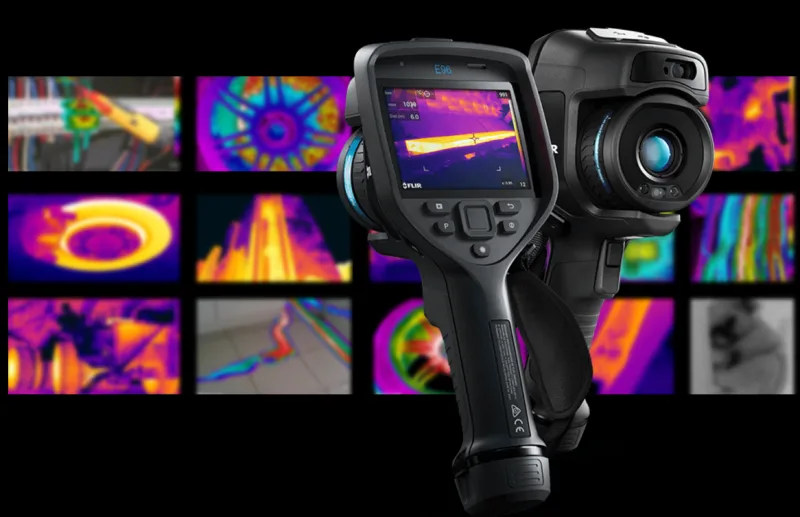
Thermal imaging changes that dynamic. Instead of waiting for a failure or relying solely on mechanical inspections, mine reliability and maintenance teams can now use their FLIR Exx, T5xx and T8xx Series cameras to monitor mobile plant equipment without disrupting production.
A trained thermographer can perform a quick scan of key components using their FLIR camera. The infrared image immediately shows temperature variations that are invisible to the naked eye — highlighting overheating bearings, misaligned gears, hydraulic faults, or inefficient cooling.
A dozer can be scanned in a timely manner to see if there are any thermal anomalies indicating a problem. This allows asset owners the opportunity to make repairs before complete failure.

Catching Failures Before They Happen
Thermal imaging condition monitoring of the dozer undercarriage allows issues like pin galling to be detected early before the fault ends up creating pin failure and a broken track.
Most objects create heat energy as a pre-cursor to a failure. Baselining a dozer’s tracks and other high wear areas upon commissioning allows us to monitor that asset through its life. We can then detect changes in temperatures over time, indicating higher heat conditions worthy of further investigation.
By detecting abnormal temperatures early, the maintenance team can schedule a planned repair during the next service window rather than face an unscheduled shutdown in the middle of a shift.
The same principle applies to other components. Thermal camera scans can reveal:
- Hydraulic faults bypassing hydraulic cylinders
- Cooling system blockages (overheating)
- Electrical faults, air conditioning diagnosis rotating equipment such as alternators, belt tensioners, and pulleys
Every one of these conditions, if left unchecked, has the potential to cause downtime.
Safety and Environmental Advantages
Thermal imaging is more than reliability and cost savings —with the new Exx & Txx Series cameras we have the options of telephoto lenses that allows us to perform diagnostic scans from a safe working distance, without effecting production.
Regular thermography surveys play a key role in the maintenance and reliability over the life of the machine. These surveys reduce unscheduled downtime and increase asset availability.
The end benefit is improved efficiency with lower maintenance costs and environmental damage through breakdowns, leakages, and poor cycle times.
Benefits of Thermal Imaging
| Category | Benefit | Detail / Impact |
| Operational | Early fault detection | By detecting faults early we avoid failure and unscheduled downtime. |
| Predictive maintenance | Enables maintenance to be planned during scheduled shutdowns, not during production hours. | |
| Financial | Reduced downtime | Hire machine availability, due to less unscheduled breakdowns. |
| Lower repair costs | This leads to lower repair costs and maximum chargeable hours. | |
| Safety | Non-contact inspection | Keeps personnel out of hazardous zones while machines are operational. |
| Sustainability | Reduced waste & emissions | Minimises part scrapping, fuel waste, and environmental spill risks. |
| Data & Reporting | Performance tracking | Builds thermal profiles for each mobile asset, improving reliability analysis. |
A Broader Future for Thermal Imaging
Modern manufacturing technologies have reduced productions costs of thermography equipment paving the way for more affordable systems to be utilised across both fixed and mobile plant.
In the commercial, industrial, civil, and mining sectors a fit for purpose thermal camera can offer savings across a business’s operations by proactively document assets thermally. This allows us to make predictive informed decision in respect to maintaining equipment at its optimal capacity.
The result is a shift toward fully predictive maintenance, where technology enables proactive decisions rather than reactive fixes. In a sector where uptime equals profitability, that’s a competitive edge every operation needs.
Thermal Camera Training
Thermal imaging represents a small investment with enormous returns for Businesses. Training along with the purchase of the Thermal equipment is an integral part of the implementation process.
Purchasing the camera is the beginning of the journey, understanding IR fundamentals, basic thermal physics, camera functionality, and operation through our ITC training will ensure return on investment through reliable repeatable consistent results.
GTEK Infrared’s thermography training options start from ½ day thermography courses, one on one delivery of cameras with training in SEQ area, through to Level I and Level 2 ITC thermography training,
If you are interested in thermal camera training or would like more information on our extensive FLIR camera range, please call 1300 416 626.